Artists Who Changed the World Forever
Artists change the world when their work escapes the studio and enters the way societies remember, protest, mourn, worship, decorate, argue, and dream. Some artists change the world through single images that become cultural memory. Others change it by inventing forms that reshape design, film, fashion, architecture, politics, or everyday visual language. Their impact is not always immediate, and it is not always comfortable. Art can console, disturb, expose, dignify, provoke, or give a community a mirror it did not know it needed. The artists in this kind of story matter because they changed what people could see together.
A: By reshaping public memory, identity, political imagination, design, or shared ways of seeing.
A: No, changes in perception, beauty, spirituality, or form can also be profound.
A: They bring art into public space where history and community can be argued visibly.
A: Yes, quilts, textiles, ceramics, and other forms can carry history and vision powerfully.
A: No, some world-changing art works through tenderness, recognition, or sustained beauty.
A: Sometimes, especially when it becomes a shared symbol during crisis or transformation.
A: Audiences, communities, institutions, critics, and later generations all participate in that judgment.
A: Yes, repetition and commercialization can dull an image, though strong work often regains power in new contexts.
A: Living artists can already reshape institutions, speech, protest, and global visibility.
A: What did this artist make visible that people could no longer easily ignore?
Changing the World by Changing Visibility
Artists change the world when they change what people can see, and visibility is never a small matter. A society acts differently when suffering has a face, when labor has dignity, when a landscape becomes sacred, when a body becomes powerful, or when violence can no longer hide behind official language. The artist’s work may begin as pigment, stone, fabric, film, or performance, but its effects can become public memory.
Michelangelo changed the world by expanding the scale of artistic ambition. His bodies made spiritual and human drama feel monumental, and his work helped define the artist as a figure of extraordinary creative authority. The consequences extended beyond individual masterpieces. The idea of the artist as genius, burdened and exalted, owes much to the kind of myth his career helped create.
Art as Witness
Francisco Goya changed art by refusing to let violence remain noble. His images of war, superstition, cruelty, and terror make viewers confront the human cost beneath official narratives. Goya’s work feels modern because it distrusts triumph. It shows that art can become witness, not by offering easy moral comfort, but by refusing to beautify brutality.
Jacob Lawrence also used art as witness, though through a different visual language. His Migration Series gave form to one of the great demographic and cultural transformations in American history. Lawrence’s panels use shape, rhythm, color, and sequence to make movement collective. The work matters because it turns history into a visual narrative that can be taught, remembered, and felt.
Ai Weiwei belongs in this discussion because his art insists that public memory is a political struggle. Through installations, documentation, architecture, and activism, he challenges censorship and state control over truth. His work shows that contemporary art can operate as evidence, protest, memorial, and international communication at once.
Imagination Against the Ordinary World
William Blake changed the world not through institutional power, but through a visionary fusion of image and text. His art insists that imagination is not decoration. It is a force of judgment against deadening systems, cruelty, and spiritual confinement. Blake’s influence reaches poets, artists, musicians, radicals, and readers who see in him a defense of inner vision against mechanical life.
Georgia O’Keeffe changed modern seeing by distilling flowers, bones, buildings, and landscapes into forms that feel intimate and vast at the same time. Her work has often been overinterpreted through biography or gendered cliché, but the paintings themselves have a severe visual intelligence. She made attention feel expansive. In doing so, she helped reshape American modernism’s relationship to landscape, abstraction, and bodily perception.
Public Walls, Public Memory
Diego Rivera changed the world by making art public, historical, and political on an architectural scale. His murals presented workers, Indigenous histories, machines, revolutions, and social conflict as subjects worthy of monumental treatment. Rivera’s art did not ask viewers to enter a private collector’s room. It met them on walls where public history could be contested.
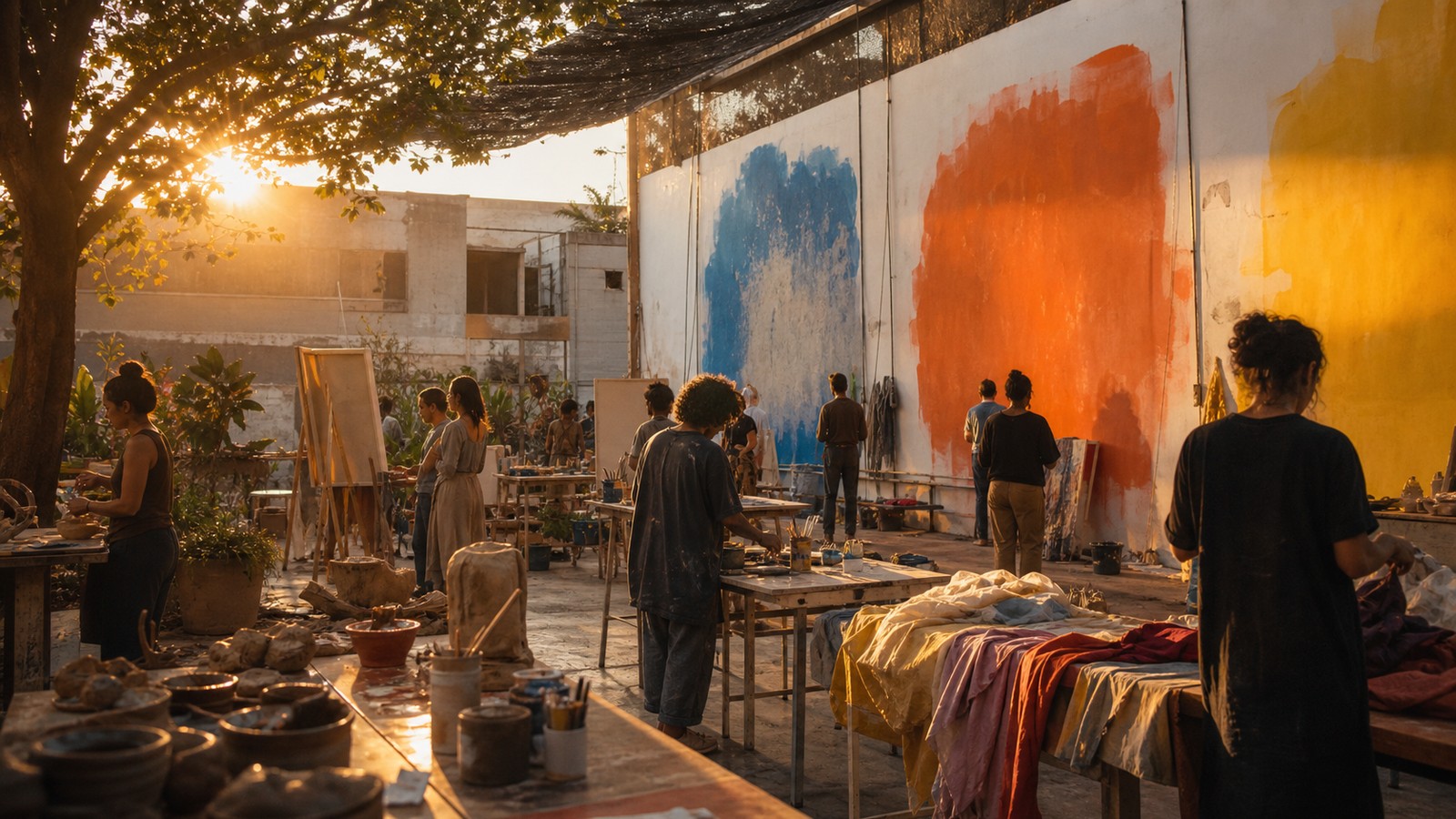
Murals matter because they change the audience. A museum visitor chooses to enter; a passerby encounters a wall. Public art can therefore become part of civic life, shaping how communities imagine labor, ancestry, injustice, and hope. Rivera’s influence can be felt wherever artists use scale and public space to claim history for people left outside official portraits of power.
Memory in Materials
Harriet Powers demonstrates that world-changing art is not limited to oil painting, marble, or museum-approved categories. Her story quilts hold biblical narrative, memory, symbol, and visual intelligence in textile form. Powers’s work challenges narrow definitions of fine art and reminds readers that materials associated with domestic labor can carry profound cultural force.
Textile art often preserves histories that formal archives neglect. It can hold family memory, theology, community pattern, and coded testimony. When later institutions recognize such work, they are not elevating craft into art as a favor. They are correcting a failure of attention. Powers’s quilts changed the world by widening what serious viewers must be prepared to see.
The Modern Visual World
Claude Monet and Pablo Picasso changed the world in ways that moved far beyond their own canvases. Monet’s attention to light helped transform perception into a modern subject. Picasso’s rupture of form helped make fragmentation a central visual language of the twentieth century. Their influence entered design, advertising, film, education, and public expectations of what modern art means.
That wide influence can make them feel overly familiar, but familiarity is part of the evidence. When a once-radical way of seeing becomes common, the world has changed. The viewer may not notice the origin because the origin has entered the background of visual culture.
Why World-Changing Art Endures
Artists who change the world forever do not all change it in the same direction. Some bear witness, some invent form, some claim public space, some preserve memory, some make identity visible, and some expose power. Their work can be beautiful, harsh, tender, monumental, private, or unsettling. What unites them is consequence.
Their art remains important because it continues to give people ways to see what might otherwise disappear. It makes grief visible, labor visible, imagination visible, injustice visible, and beauty visible in unfamiliar forms. The world changes when people see differently enough to remember differently, argue differently, and sometimes act differently. That is the power these artists leave behind.
Art as a Public Language
When artists change the world, they often give people a public language for experiences that were scattered or silenced. Goya gave visual form to the horror beneath heroic war. Lawrence gave the Great Migration a sequence that could be held in memory. Rivera gave labor and history monumental walls. Powers gave textile form to sacred story and cultural memory. These artists did not simply express themselves. They created shared images through which others could think.
A public language matters because social life depends on what can be recognized. If suffering has no image, it is easier to ignore. If labor has no dignity in public art, it is easier to treat workers as background. If a community’s memory has no respected form, it is easier to dismiss. Artists change the world by changing the symbolic resources people can use to claim reality.
Beauty, Protest, and the Long View
It is tempting to separate beautiful art from political art, but many world-changing artists show how false that split can be. Rivera’s murals depend on composition, color, and rhythm as much as ideology. Lawrence’s panels are formally elegant as well as historically urgent. Kahlo’s symbolic selfhood is visually compelling before it becomes a cultural emblem. Ai Weiwei’s work can be conceptually sharp, documentary, and visually powerful at once.
Protest that lacks form may vanish quickly. Beauty that refuses reality may become decoration. The artists who change the world often hold form and urgency together. Their work remains visible because it gives social feeling a shape strong enough to survive beyond the immediate crisis.
The Afterlife of World-Changing Images
Once an artwork enters public memory, it rarely stays fixed. It may be printed on posters, quoted in murals, studied in classrooms, used in protests, adapted in fashion, circulated online, or softened into merchandise. This afterlife can spread the work’s reach while also diluting its difficulty. Kahlo’s face, for example, has traveled so widely that the harder strangeness of her paintings can be overshadowed. Goya’s antiwar images can be admired aesthetically while their accusation remains uncomfortable.
The task for readers is to return to the work itself. Ask what made it powerful before it became familiar. Ask who needed it, who feared it, and who changed because of it. World-changing art deserves more than recognition. It deserves renewed attention.
When Art Changes Communities
World-changing art is not always global at first. Sometimes it changes a community before it changes museums or textbooks. A mural can give a neighborhood its history back. A quilt can preserve family memory. A photograph can help a movement recognize itself. A performance can gather people into shared risk. The scale of change begins with recognition: people see something and understand that their experience has entered public form.
This community scale matters because global fame can obscure the first audience. Rivera’s murals spoke to workers and public histories, not only art historians. Lawrence’s migration panels spoke to people whose families carried that movement in memory. Powers’s quilts spoke through material traditions that academic art history long undervalued. Ai Weiwei’s installations speak across borders, but they often begin from specific acts of erasure or injustice. The world changes through particular places before it becomes an international story.
The Courage to Make Memory Visible
Memory can be dangerous when power depends on forgetting. Artists who change the world often insist that memory take form: a body, a wall, a sequence, a symbol, a public object, a repeated image. Once memory is visible, it can be shared, disputed, censored, protected, or carried forward. Art gives memory a shape that can survive beyond the people who first needed it.
That is why these artists matter so deeply. They do not simply decorate culture. They help decide what culture is able to remember. Their work can become a meeting place for grief, pride, anger, reverence, and hope. A society’s future is shaped partly by what it can bear to see, and these artists made seeing harder to avoid.
Seeing as a Form of Change
Their lasting lesson is that seeing is not passive. To see a worker, a wound, a migration, a body, a sacred story, or a censored memory differently is already to live in a changed world. Art does not replace law, medicine, food, or shelter, but it changes the imagination through which people pursue them. That is why world-changing artists remain necessary.
Their influence is therefore larger than style. It lives in memorials, movements, classrooms, neighborhood walls, museum debates, and private moments when a viewer suddenly recognizes a truth that had been unnamed. Once that recognition happens, culture has already shifted.
For that reason, these artists belong not only in art history but in the broader history of human consciousness. They changed the images through which people recognize pain, dignity, beauty, power, and belonging.
That recognition can begin quietly, with one viewer, but it can also gather force until a community, a movement, or an institution has to respond.
That response is where art becomes historical force, not merely personal expression.
That force keeps returning whenever images help people understand what is at stake.