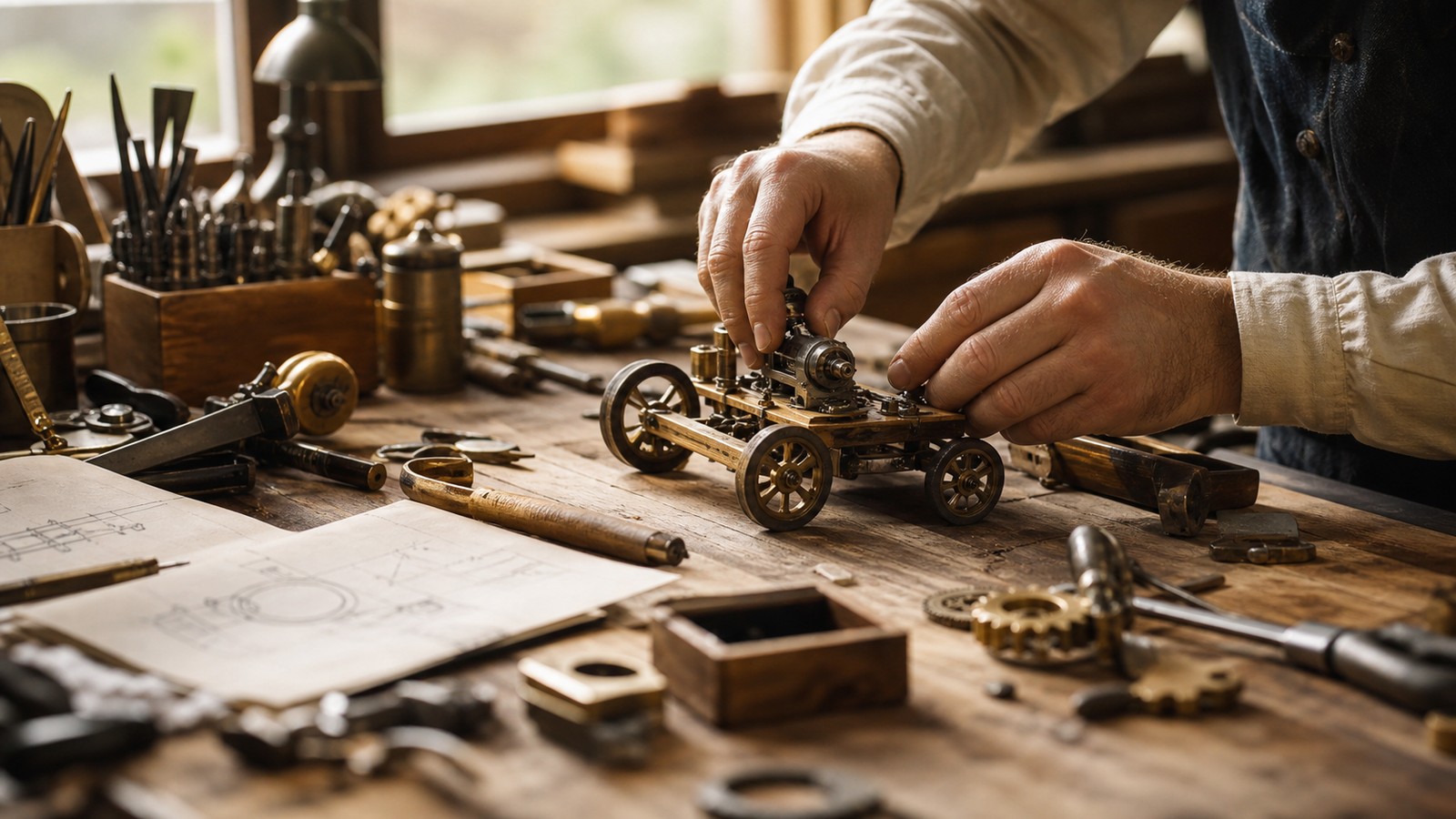
The Greatest Inventors in History
The greatest inventors in history were not merely people with clever ideas. They were builders of possibility. They noticed friction in ordinary life, imagined a different tool or system, and then endured the stubborn work of making it function outside the mind. Some invented devices; others improved processes, materials, machines, or networks that changed daily life at scale. Invention is practical imagination under pressure. It depends on curiosity, craft, timing, failure, and often a surrounding world of assistants, financiers, workshops, and users. Biography turns invention from a list of objects into a story of persistence and consequence.
A: A practical creation or improvement that changes how people live, work, communicate, move, or solve problems.
A: No, many inventions depend on teams, prior discoveries, suppliers, and users.
A: A refinement can make an idea reliable, affordable, scalable, or safe enough to matter.
A: They document claims, but historical impact depends on use, adoption, and consequences.
A: Yes, useful technologies can also intensify exploitation, inequality, or harm.
A: Science seeks understanding, while invention turns understanding, craft, or need into practical tools.
A: Programming and networks changed the tools through which modern society thinks and communicates.
A: Failure exposes design assumptions and turns imagination into tested engineering.
A: By looking beyond the famous name to collaborators, institutions, and users.
A: Their lives show how practical creativity can reshape everyday possibility.
Invention as Practical Imagination
Invention begins where imagination meets resistance. A person sees that a task could be done differently, but the world does not immediately cooperate. Materials break, machines jam, users improvise, costs rise, and rivals race ahead. The greatest inventors are not simply dreamers; they are people who stay with the problem long enough for an idea to become usable. That is why invention belongs as much to workshops, laboratories, factories, and field tests as to sudden inspiration.
Johannes Gutenberg’s importance shows how invention often combines existing elements into a new system. Presses, ink, paper, metalworking, and movable type all had histories, but Gutenberg’s achievement lay in bringing production together with enough technical discipline to transform communication. Printing changed religion, scholarship, administration, and public argument. The invention mattered because it could be repeated, scaled, and trusted. A single beautiful object would not have changed history in the same way.
Power, Industry, and the Machine Age
James Watt is remembered not because he invented steam from nothing, but because his improvements made steam power more efficient and more useful. That distinction is crucial. Many great inventors are refiners, system builders, and practical improvers. Watt’s work helped accelerate industrial production, mining, transport, and the reorganization of labor. The consequences were enormous, including both prosperity and exploitation. Biography should hold both realities together, because invention changes society through use, not through intention alone.
Eli Whitney’s legacy is one of the clearest reminders that invention can be historically important and morally troubling. The cotton gin increased the efficiency of processing cotton, but it also strengthened the economic engine of slavery in the American South. Whitney is also associated with interchangeable-parts manufacturing, an idea that helped shape industrial production. His life shows why inventors cannot be studied only through cleverness. The social conditions around an invention determine whether it liberates, accelerates harm, or does both at once.
Nikola Tesla’s work on alternating-current electrical systems helped define the modern electrical world. Tesla’s biography is often wrapped in myth, but the real achievement is strong enough without exaggeration. He contributed to technologies and ideas that made long-distance electrical transmission more practical and helped shape the infrastructure of modern life. His story also reveals how invention depends on finance, publicity, patents, and industrial competition. A brilliant idea still has to survive the business of becoming real.
Communication, Computation, and Hidden Signals
Granville T. Woods, sometimes called the Black Edison by newspapers of his era, earned numerous patents connected to railways and electrical systems. His work improved communication and control in a world where rail travel demanded coordination and safety. Woods’s career matters not only for the inventions themselves, but for what it reveals about Black technical achievement in a society structured by discrimination. Recognition was harder won, and biography helps restore the scale of effort behind the patents.
Hedy Lamarr’s inventive work is a striking example of a public figure whose technical imagination was long overshadowed by celebrity. With composer George Antheil, she co-developed a frequency-hopping concept intended to help secure wartime communication. The idea’s later association with wireless technologies has made Lamarr a symbol of overlooked ingenuity. Her story is valuable because it unsettles assumptions about who gets imagined as an inventor. Technical creativity does not always arrive wearing the costume society expects.
Programming, Materials, and Modern Systems
Grace Hopper changed computing by helping make programming more accessible and portable. Her work on compilers and programming languages moved computers away from being machines only specialists could command in the most direct terms. Hopper’s influence reminds us that invention can be linguistic and conceptual. A tool becomes more powerful when more people can tell it what to do. In that sense, programming languages are inventions of access as well as computation.
Stephanie Kwolek’s invention of Kevlar shows the transformative power of materials science. Kevlar’s strength and lightness led to uses in protective gear, cables, tires, and industrial applications. The invention did not simply create a new product; it created new design possibilities wherever strength, weight, and durability mattered. Kwolek’s career also helps broaden the popular image of invention beyond gears and engines. A fiber can change the world as surely as a machine.
Information Worlds and Collective Use
Tim Berners-Lee’s creation of the World Wide Web changed modern life by making linked information broadly navigable through an open system. Its significance lies partly in design and partly in philosophy. By keeping the web open, Berners-Lee helped create a platform that others could build upon at enormous scale. The later history of the web includes creativity, commerce, misinformation, community, surveillance, and conflict, but the original invention remains one of the defining tools of the modern age.
Katherine Johnson’s mathematical work for spaceflight also belongs near the border of invention, calculation, and applied science. She did not invent a household device, but her precise work helped make missions possible. Including her in this conversation reminds readers that the practical transformation of the world often depends on calculations, procedures, and verification that do not look like traditional inventions. Sometimes the tool is a method. Sometimes the breakthrough is a number trusted enough to carry human lives.
How to Judge Inventive Greatness
The greatest inventors in history should be judged by more than novelty. Originality matters, but so do reliability, adoption, scalability, safety, and consequence. A device that works once in a demonstration may be impressive; a system that changes ordinary life is historically transformative. The path from idea to impact usually passes through manufacturing, distribution, repair, training, standards, and public trust.
It is also important to distribute credit more honestly than older histories often did. Invention is rarely solitary. Machinists, assistants, programmers, laboratory partners, users, and funders all shape whether an idea survives. The famous name may be real, but it is seldom the whole story. Studying inventors well means honoring imagination while also following the networks that made imagination useful.
These lives matter because invention remains one of humanity’s most powerful forms of hope. To invent is to insist that some limit is not final. The greatest inventors did not merely add objects to the world. They changed what people could do, expect, repair, protect, share, and imagine. Their biographies remind us that practical creativity can alter everyday life more quietly than politics, but just as deeply.
From Device to System
An invention changes history when it becomes part of a system. Gutenberg’s press mattered because it could produce many pages with consistency. Watt’s improvements mattered because they connected to mines, factories, fuel, investment, and transport. Tesla’s electrical work mattered because power generation and transmission required networks, standards, and adoption. A device alone may be brilliant, but a device inside a system can reorganize society.
This is why the greatest inventors often seem to stand at crossroads. They understand the object, but they also understand the conditions around the object. What must be manufactured? Who will use it? How will it be repaired? What existing habit must change? Which cost must fall? Which danger must be reduced? Invention becomes world-changing when those questions are answered well enough for the new tool to leave the workshop.
Ethics at the Workbench
Inventors do not control every use of what they create, but invention is never ethically empty. Whitney’s cotton gin is the classic warning: a technical improvement can strengthen an unjust system when the surrounding economy rewards exploitation. Military research, surveillance tools, industrial machines, and digital platforms all raise similar questions in different forms. The inventor’s biography is therefore not only a story of ingenuity. It is also a story about responsibility in a world where tools travel beyond their first purpose.
Ethical judgment should be careful rather than simplistic. Some inventions save lives and create new risks at the same time. Some tools are designed for one setting and adapted for another. Some inventors understand the consequences clearly; others do not. What matters is that readers ask the question. A useful invention can still deserve moral scrutiny, and a troubling legacy can still teach how technology and society shape one another.
The Users Who Complete an Invention
Users are often the final collaborators. They discover shortcuts, expose weaknesses, demand changes, repair failures, and carry the invention into settings the original designer never imagined. The World Wide Web grew because people built pages, browsers, communities, businesses, archives, and tools on top of an open structure. Programming languages matter because programmers use them to create new worlds of work. Protective materials matter because soldiers, firefighters, engineers, and workers trust them in practical conditions.
This user-centered view makes invention more democratic. It does not deny the inventor’s insight, but it shows that impact depends on adoption. A technology becomes historical when people weave it into ordinary practice. The greatest inventors changed the world because their creations did not remain private achievements. They became shared instruments of life, labor, safety, communication, and imagination.
Why Inventors Still Inspire
Inventors inspire because they make change feel tangible. A political ideal may be abstract, and a scientific theory may require years of study, but an invention can be held, used, repaired, shared, and improved. It enters the texture of life. People know the world has changed when a message travels faster, a material protects better, a machine saves labor, or information becomes easier to reach. Invention turns possibility into contact.
The greatest inventors also remind readers that creativity is not separate from persistence. Every working tool hides discarded versions, stubborn defects, and moments when the idea almost failed. That is why their biographies are useful beyond technology. They teach a general form of resilience: notice the problem, build a response, learn from resistance, and keep refining until imagination can survive reality.
Invention and Everyday Memory
Many inventions become so successful that people stop noticing them. Printed pages, electric light, wireless signals, strong protective fibers, software languages, and linked information feel ordinary once they become part of daily life. That ordinariness is itself a sign of impact. The invention has moved from novelty into expectation. It no longer announces itself because it has changed the background conditions of living.
Biography restores the drama hidden inside that familiarity. It returns readers to the years when the outcome was not obvious, when a machine failed, a patent was challenged, a material behaved strangely, or a new system needed advocates. The greatest inventors remind us that the ordinary world is built from once-unproven ideas. Their lives make daily tools feel less inevitable and more astonishing.