The Greatest Scientists of All Time
The greatest scientists are not simply people who knew more than their contemporaries. They changed the methods, questions, and evidence by which knowledge could grow. Some looked at the heavens and altered humanity’s place in the universe. Others studied motion, life, disease, radiation, inheritance, computation, or the hidden structure of matter. Their greatness lies in disciplined imagination: the ability to notice what others missed, doubt what others repeated, and build explanations strong enough for later generations to test. Biography helps make that greatness human. Behind each discovery stood habits of patience, rivalry, error, courage, and wonder.
A: A discovery or method that permanently changes how later researchers understand and investigate the world.
A: No, clarifying, proving, measuring, or explaining can matter as much as priority.
A: Science is collaborative, competitive, and dependent on institutions that have not always recognized contributors fairly.
A: Yes, a mistaken theory can sharpen questions or produce evidence that leads elsewhere.
A: Rarely; even solitary thinkers depend on teachers, instruments, letters, critics, and predecessors.
A: Their abstract work can transform scientific method, modeling, and technology.
A: Treat famous stories as starting points, then compare them with records and context.
A: Often, especially when evidence challenges authority, reputation, or personal safety.
A: Failure tests assumptions and can reveal which part of a question was misunderstood.
A: It shows discovery as a human discipline built from curiosity, doubt, labor, and proof.
Greatness as a Change in Method
A scientist becomes historically great when their work changes more than a fact. Facts matter, of course, but the largest scientific lives alter the way facts can be found, connected, and trusted. Ibn al-Haytham’s work on optics, for instance, is admired not only for conclusions about vision and light, but for the seriousness of experiment and observation in his inquiry. He helped model a disciplined way of asking nature to answer back. That habit is one of science’s most important inheritances.
Copernicus and Galileo changed method in another way. Copernicus proposed a heliocentric model that unsettled inherited cosmology, while Galileo’s telescopic observations gave new force to the idea that instruments could extend human perception beyond ordinary authority. Their stories are not identical, yet together they show a major shift: old books were no longer enough. The heavens could be observed, measured, argued over, and reimagined. A scientist’s greatness often begins when a familiar world becomes newly questionable.
The Power of Unifying Ideas
Isaac Newton’s achievement remains one of the clearest examples of scientific greatness because he unified phenomena that had seemed separate. The motion of falling objects and the motion of celestial bodies could be understood through the same mathematical framework. That kind of synthesis changes the scale of human understanding. It does not merely answer a question; it reveals that several questions were part of one larger structure.
Albert Einstein later transformed physics by rethinking space, time, gravity, and light. Relativity was not just a correction to older mechanics in extreme conditions. It forced a deeper reconsideration of assumptions that had felt obvious. Einstein’s greatness lies partly in imagination disciplined by mathematics and physical insight. He could ask what the world would look like from a different frame and then follow that question into equations that experimental science could test.
Unifying ideas are powerful because they reorganize intellectual territory. After Newton, motion had a new language. After Einstein, time and space could no longer be treated as simple background. Great scientists give later minds a map that makes previous knowledge look both useful and incomplete.
Measurement, Classification, and the Remaking of Fields
Antoine Lavoisier’s importance shows that scientific revolutions can be administrative as well as conceptual. By emphasizing careful measurement, chemical nomenclature, and conservation of mass, he helped move chemistry away from older explanatory systems and toward a more precise modern discipline. The work may appear less romantic than a telescope pointed at the stars, but it was transformative. Measurement gave chemistry a sturdier grammar.
Charles Darwin transformed biology by giving adaptation and diversity a historical mechanism. Natural selection changed the meaning of species, variation, inheritance, and time. It also provoked resistance because it touched religious, philosophical, and cultural assumptions about human place in nature. Darwin’s greatness was not only that he proposed a powerful idea, but that he assembled evidence across breeding, geography, fossils, and natural history into an argument that remade the field.
Scientists Who Expanded the Possible
Ada Lovelace occupies a distinctive place because her scientific imagination reached beyond the machinery available around her. In writing about the Analytical Engine, she saw that computation might manipulate symbols and patterns, not merely numbers. Her importance is not the same as that of a laboratory experimentalist, but it belongs to the history of scientific possibility. She perceived a future logic before the future had its machines.
Marie Curie’s career shows another kind of expansion. Her work on radioactivity required technical skill, physical endurance, and unusual persistence in institutions that were not built to welcome women as scientific equals. Curie helped open a field whose implications reached medicine, physics, chemistry, and the modern understanding of matter. Her biography is often told as heroic sacrifice, but it should also be understood as disciplined research under difficult conditions.
Credit, Evidence, and the Human Reality of Discovery
Rosalind Franklin’s role in DNA research is essential because it reveals how scientific discovery depends on evidence, interpretation, and credit. Her X-ray diffraction work provided crucial insight into DNA’s structure, yet public recognition lagged behind the importance of her contribution. Franklin’s story helps correct the misleading idea that science advances through lone geniuses who simply announce truth. Evidence often passes through laboratories, rivalries, gendered institutions, and publication systems before the world understands what happened.
This does not diminish science. It makes science more human and more demanding. The greatest scientists worked inside communities of tools, teachers, technicians, competitors, patrons, journals, and critics. Their brilliance mattered, but so did the conditions that allowed or obstructed their work. When readers study scientific biography, they should ask not only who discovered something, but how the discovery became credible and who was allowed to receive credit for it.
Why the Greatest Scientists Still Matter
The greatest scientists of all time remain important because they changed humanity’s relationship to reality. They made the universe larger, matter stranger, life older, disease more investigable, and knowledge more disciplined. They showed that wonder does not have to oppose rigor. In the best science, wonder becomes more powerful because it is tested.
Their biographies also teach intellectual character. Curiosity matters, but curiosity alone is not enough. Great science requires patience, skepticism, courage, precision, and the willingness to be corrected. These lives remind us that knowledge is not a possession handed down fully formed. It is a practice renewed by every generation willing to look again, measure more carefully, doubt honestly, and ask better questions of the world.
The Courage to Disturb Certainty
Scientific greatness often requires disturbing what intelligent people once considered settled. Copernicus challenged inherited cosmic order. Darwin unsettled comforting ideas about species and human uniqueness. Einstein revised assumptions about time and space that had felt almost self-evident. These scientists did not merely add new details to an accepted picture. They forced a change in the picture itself, which is why their work met resistance as well as admiration.
That kind of courage is not theatrical. It is quieter and more disciplined. A scientist must be willing to follow evidence into intellectual loneliness, but also willing to submit the claim to tests, criticism, and revision. The courage of science is not the courage to believe whatever one wants. It is the courage to let reality push back. That is a harder standard than confidence, and it is one reason the greatest scientific biographies still feel alive.
Tools That Changed What Could Be Known
Many great scientific careers are inseparable from instruments. Galileo’s telescope did not simply magnify objects; it magnified the authority of observation. Franklin’s X-ray diffraction images made molecular structure visible in a new way. Curie’s laboratory techniques helped isolate and investigate phenomena that earlier vocabularies could not explain. Instruments create new evidence, and new evidence changes what counts as a serious argument.
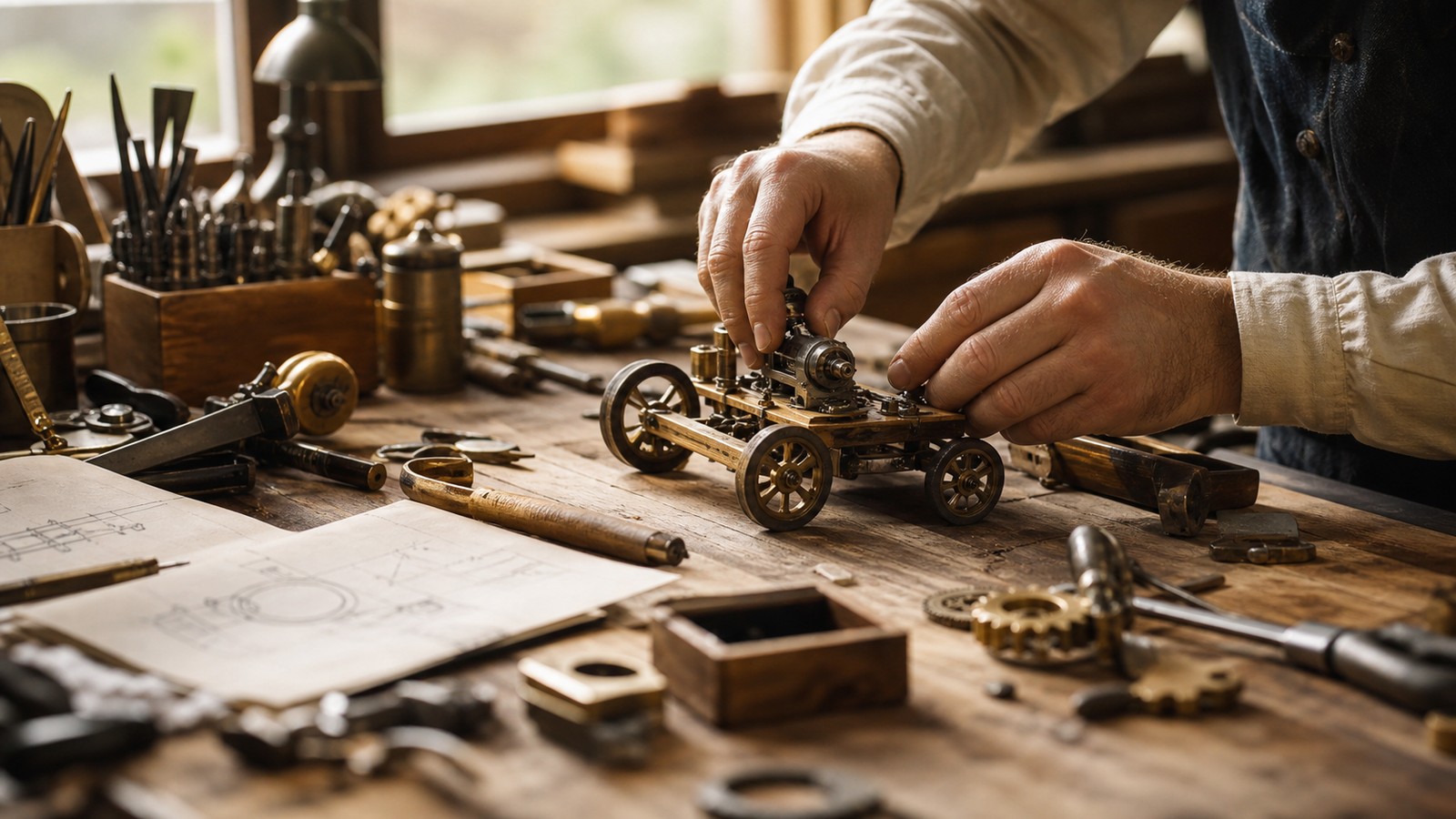
Tools also remind us that science is material labor. Glass must be ground, samples prepared, plates exposed, measurements repeated, machines calibrated, and results recorded. The public often remembers the final theory, but the theory rests on a world of handling, measuring, and correcting. When readers study scientists through their tools, discovery becomes less like magic and more like a demanding craft.
Why Scientific Legacy Keeps Changing
The reputation of great scientists is not fixed forever. New research can revise the story of priority, restore overlooked collaborators, or show that a celebrated thinker misunderstood part of their own discovery. Franklin’s public reputation changed as more readers understood the importance of her DNA work. Lovelace’s significance has been reconsidered as computing became central to modern life. Even Newton and Einstein are read differently as historians ask new questions about institutions, correspondence, and intellectual context.
This changing legacy is healthy. Science itself advances by revision, and the history of science should do the same. The goal is not to dethrone every famous name, but to make the story more accurate and generous. The greatest scientists remain great when their work can survive better history. In fact, a fuller account often makes their achievements more impressive because it shows the real difficulty behind them.
Science as a Shared Inheritance
The greatest scientists leave more than discoveries. They leave habits of inquiry that other people can inherit. A student using a microscope, a programmer testing a model, a doctor interpreting evidence, or a citizen asking for proof is participating in a culture these scientists helped build. The inheritance is not a set of untouchable answers. It is a disciplined way of moving from curiosity to evidence and from evidence to better questions.
This matters especially in an age crowded with confident claims. Scientific biography reminds readers that real knowledge is slower and more demanding than assertion. It requires records, methods, criticism, replication, and the humility to revise. The greatest scientists are inspiring not because they were always right, but because their best work made it harder for everyone else to be carelessly wrong.
The Beauty of Corrected Understanding
One of the most moving features of science is that correction is not failure at the deepest level. It is the path by which knowledge becomes stronger. Newton did not become useless because Einstein revised the framework of physics; Newtonian mechanics remained powerful within its domain. Earlier biological observations did not vanish because genetics and molecular biology deepened evolutionary theory. Scientific greatness often survives correction because it gave later researchers something sturdy enough to refine.
This makes scientific biography different from simple celebration. The greatest scientists are not marble figures handing down final truths. They are participants in a long conversation with nature and with one another. Their best work creates more work. It opens problems, methods, instruments, and questions that later minds can pursue. That is why their greatness feels active rather than finished.
Readers who understand this become less vulnerable to false certainty. They can admire discovery while expecting revision. They can respect expertise without treating it as magic. Above all, they can see science as an honest discipline of correction, which may be one of humanity’s most important inventions.
The Reader’s Scientific Imagination
Studying these lives can also change how readers encounter the modern world. A weather forecast, vaccine, satellite image, genetic test, search algorithm, or medical scan carries a lineage of questions asked by earlier scientists. Those tools can feel detached from biography, yet they descend from people who argued over evidence, refined instruments, and accepted the discipline of proof. Remembering that lineage makes scientific knowledge feel less anonymous and more human, and it makes curiosity feel like a shared inheritance.